Simulators
Lottery Draw Machine: How a Drum Mixes Balls
The simulator below mixes numbered balls in a flat drum and draws a full set for the game you pick. Run many draws and compare how often each ball comes out.
Loading the simulator
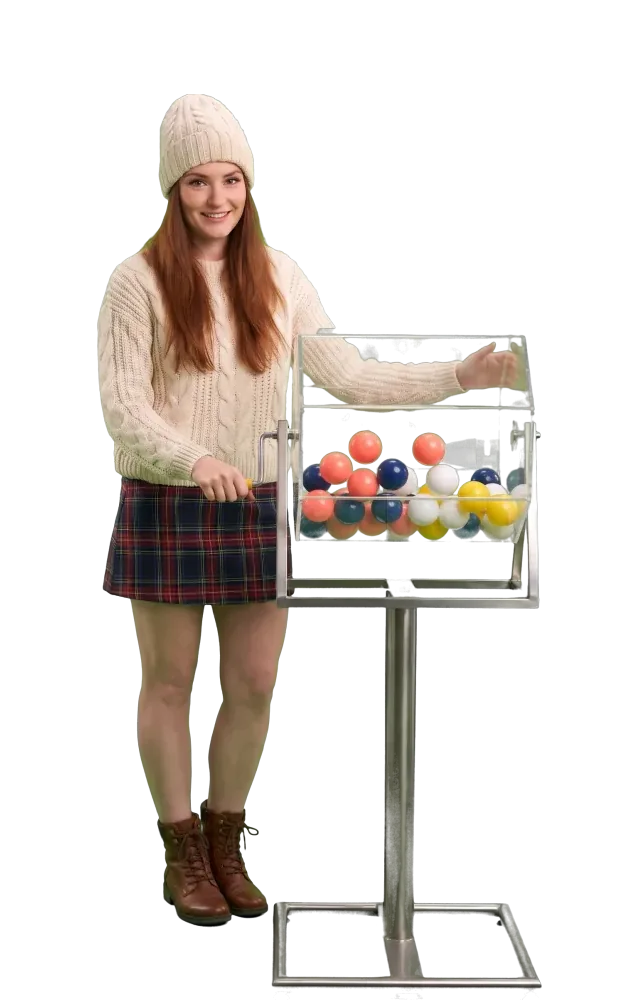
What the machine does
- Load all the ballsEvery number in the game goes into the drum as one ball. Each draw starts with the full set.
- MixThe drum moves the balls so they bounce off the walls and each other, so the order in which balls come out cannot be predicted.
- Release one ballOne ball leaves the drum. Its number is part of the result and it stays out for the rest of this draw.
- Repeat until completeMixing and releasing continue until the game's set is drawn. In Lotto Max, that is the main numbers and the bonus number, all different.
- Return all the ballsAll balls go back for the next draw. The drum does not remember what came out before.
Chance for one ball
Chance a ball is one of the main numbers = main numbers drawn ÷ balls in the drum
Example: For example, in Lotto Max any single ball has a 13.5% chance to be one of the main numbers in a draw.
Few draws vs many draws
After a few draws
- Some balls have come out several times
- Some balls have not come out at all
- The counts look uneven
- This is normal for chance
After many draws
- Every ball has come out
- The gap between balls is small compared to the totals
- Each ball's share of draws is similar
Many draws, similar shares
| What you see | What it means |
|---|---|
| One ball has the highest count | This is normal variation; its chance next draw is unchanged |
| One ball has the lowest count | It is not due; its chance stays the same |
| A spread between counts | The spread that chance alone gives |
| Each ball's share of draws grows more similar | Every ball has the same chance each draw |
Each draw is independent: in Lotto Max every ball keeps the same 13.5% chance to be a main number, whatever happened before.
The simulator vs a real machine
This 2D drum
- Flat drum on your screen
- Balls move by simulated physics
- Draw any game, as often as you like
- Shows counts over many draws
- No tickets, no prizes
A real lottery draw
- Run by the game's organiser
- Lotto Max: ILC has the numbers drawn at random
- Draw results decide real prizes
Why the start does not matter
Starting order
Where a ball sits before mixing does not change its chance. After mixing, the starting position does not affect which ball comes out.
Past draws
The machine has no memory. Last draw's numbers have the same chance as any other.
The number on the ball
Low, high, lucky or unlucky – every number is one ball with the same chance.
More simulators
Try keno and lottery simulators that show the same math in other games.
Sources
- OLG – Lotto Max Game Conditions · checked Oct 29, 2026
- OLG – Conditions de jeu du Lotto Max · checked Oct 29, 2026
Questions
How does a lottery draw machine work?
It mixes all the numbered balls in a drum and releases them one at a time until the set is complete. In Lotto Max, the main numbers and the bonus number, all different, are drawn at random.
Can a lottery ball machine be biased?
A fair draw gives every ball the same chance. Uneven counts after a few draws are what chance alone produces, not proof of bias. In the simulator, each ball's share of all draws gets closer to the same value as draws pile up.
Is the 2D drum the same as a real lottery machine?
No. It is a flat drum with simulated physics, made to show the idea: mixing, random release and equal chance for every ball. It does not copy any real machine.
Is a ball that came out often more likely next draw?
No. Each draw is independent. In Lotto Max, every ball keeps a 13.5% chance to be one of the main numbers, no matter how often it came out before.